Pre-program

Updated: Jan 5, 2022
Pre-program is a term to describe an exploratory period during which individuals interested in conservation become thoroughly acquainted with the profession and the commitment required to attain an advanced conservation degree. They also undertake the fulfilment of various prerequisites for graduate programs in conservation. There are only a limited number of undergraduate programs designed to prepare students for graduate-level conservation studies. Many students discover conservation as a career option only after they have completed their undergraduate program and must seek additional opportunities to obtain the required courses, skills, and experience required for admission. To gain exposure to conservation, many pre-program students will work in a conservation facility, typically as pre-program interns, volunteers, or as paid technicians.

Step 1: Prerequisite Coursework
Undergraduate Coursework — Prerequisites for admission to graduate conservation programs include undergraduate coursework in the sciences, humanities, and studio art. Program-specific admission requirements vary and potential candidates are encouraged to contact the programs directly for details on prerequisites, application procedures, and program curricula. With careful planning, an undergraduate curriculum can be tailored to satisfy the academic requirements of these graduate programs.
Sciences — One full year each of general and organic chemistry with the laboratory is typically required. These courses are often freshman and sophomore-level requirements for chemistry and biology majors. Not required but beneficial supplemental areas of study include biology, biochemistry, geology, materials science, physics, and mathematics.
Humanities — Broad-based coursework in art history, anthropology, and archeology should span a range of cultural traditions and historical periods. At least four to six courses are typically required.
Studio Art — Formal coursework in drawing, painting, printmaking, bookbinding, photography, and three-dimensional design (including, but not limited to, ceramics, metalworking, sculpture, and textile art) is often required. Upon application to a graduate conservation program, candidates are expected to present a portfolio demonstrating manual dexterity, knowledge of techniques, and an understanding and affinity for art materials.
Languages — Reading proficiency in one or more languages other than English is recommended and may be required to complete graduate education.
Additional Coursework — Courses in museum studies, drafting, computer science, and library science can strengthen a candidate’s application.
Step 2: Undergraduate Programs in Conservation
While curricula and program structures vary, these degree programs are designed to prepare students with the requisite coursework for graduate training programs. They typically include support for internships and other practical training opportunities and may require one or more for graduation. These programs should include significant coursework in studio art, art history, and chemistry as outlined above, and may include specific classes on conservation topics. It is important to confirm that the program you are considering is part of an accredited university and has a qualified conservator guiding the program and advising the students.
Career Path: A bachelor’s degree in conservation provides an introduction to the ethics and principles of conservation, but this degree alone does not prepare you to become a professional conservator without additional training. It may prepare you for internships, technician positions, allied professions, graduate school in other disciplines, or graduate conservation programs.
Step 3: Professional Experience
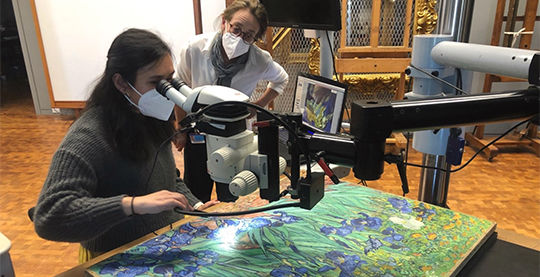
In addition to coursework, candidates for graduate programs are strongly encouraged (if not required) to have some practical conservation experience. Applicants are expected to be thoroughly acquainted with conservation as a career option and to have a fundamental knowledge of conservation philosophy, ethics, and basic working procedures. Internships, volunteer, and paid positions in regional, institutional, or private conservation laboratories are appropriate ways to gain experience and exposure. Involvement in supervised collections care projects — such as collection assessments, rehousing, and exhibition design, as well as the examination and treatment of individual artefacts, are encouraged. Apprentice training was a more common pathway to becoming a professional conservator before graduate conservation programs were established. Today, most aspiring conservators will complete one of these degree-granting programs.
Pre-program Volunteer Positions
Volunteers work in conservation labs and provide assistance with various tasks. These tasks may include documentation and condition reporting, conducting surveys, conservation treatments, and housing of objects.
Career Path: Pre-program volunteer positions can provide training for paid or formal internships, technician positions, allied professions, or graduate programs. Typically, a volunteer will use the opportunity to learn more about conservation and may choose to pursue further training or a paid position.
Pre-program Internships
Pre-program internship tasks are similar to volunteer work but should emphasise learning and include opportunities for involvement in decision-making and research, working directly with conservators. Internships can be paid or unpaid and are often short-term or part-time. Read our pre-program internship guidelines.
Career Path: Pre-program internships can provide training for technician positions, allied professions, or graduate conservation programs, and contribute toward preparation for professional conservation positions. Typically, an intern pursues further training or a paid position after gaining competence.
Technicians Positions
Technicians are paid employees who perform a limited set of specialised tasks in a conservation lab. Typical duties for a technician include producing custom housings for objects and performing specific types of basic conservation treatments under the direction of a conservator. While there may be opportunities for training and development, most technician positions are not specifically designed as educational opportunities and can include repetitive work. Technicians often develop deep knowledge and valuable skills in one specialised area.
Career Path: A technician position can provide an aspiring conservator with the pre-program experience required by many graduate conservation programs. The technician’s role can itself be a rewarding career path.
Step 4: Find an Opportunity
Supervising pre-program volunteers and interns requires a substantial time commitment on a conservator’s part, and some institutions do not accept unpaid workers as a matter of policy. For these reasons, not all labs are able to take on aspiring conservators.
Pre-program opportunities are not always formally announced and are often arranged by contacting a conservation lab or becoming involved with a regional conservation organisation.
Many libraries and museums have permanent conservation technician positions.
Step 5: What's Next?
After acquiring a range of prerequisites, many students go on to earn a master's degree from a graduate program in conservation. Others may find that the skills they have developed are well-suited to careers in allied professions such as Collections Care, Exhibition Design, Museum Studies, Archiving, Technical Art History, or Conservation Science.


Comments